Home Biography Books & Articles Events Writing Talk Workshops


Creative Nonfiction

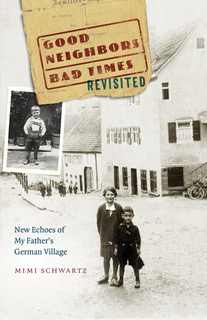
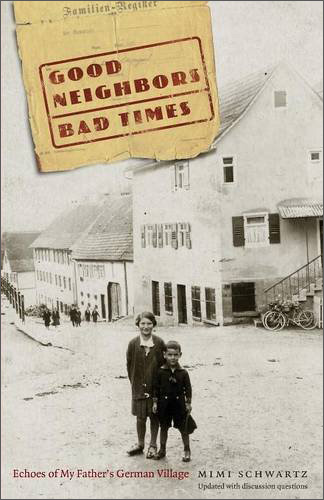
Good Neighbors, Bad Times Book CoverGood Neighbors, Bad Times:
Echoes of My Father’s German Village
In a little Black Forest village, a Torah was rescued on Kristallnacht—not by the Jews but by the Christians. Mimi Schwartz sees the Torah 40 years later and wonders who saved it and why? Her father came from the village, but as he is no longer around to ask, she reenters his old world through the kitchens and living rooms of villagers who left (the Jews) and those still living there today (the Christians). She wants to know how they neogiated decency before, during, and after the Nazi years. As stories overlap, inform, and challenge each other, they reveal the lives of people, neither heroes nor villains, whose struggles are often lost in the larger narrative of Holocaust. More than dramatic tales of rescue or betrayal, these small stories, Schwartz concludes, makes us ask more soberly: What would I have done and what would I do now? Read more...

Read the interview

Available at amazon

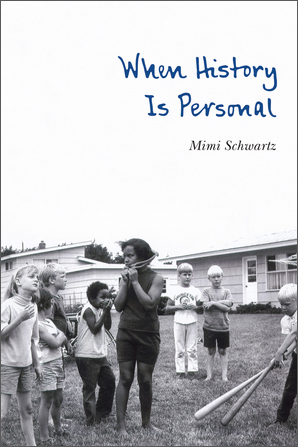
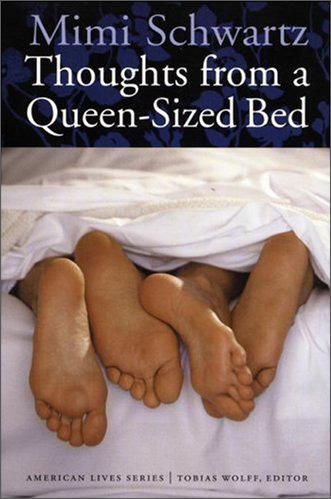
Thoughts Book CoverThoughts from a Queen-Sized Bed
In this startlingly funny and honest book, Mimi Schwartz describes what it means to be married for almost forty years. She writes with a keen and amused eye about growing up in an immigrant family, coming of age in New York in the 1950’s, marrying her high school beau, and then arriving at feminist consciousness in the 1970’s like so many others of her generation. But unlike many of her contemporaries who left first marriages for independence, Schwartz stayed loyal to her marriage. Schwartz’s essays are wise and warm without being sentimental, and the characters in her world are quirky, charming, well rounded, and complex. Read more...

Available at amazon

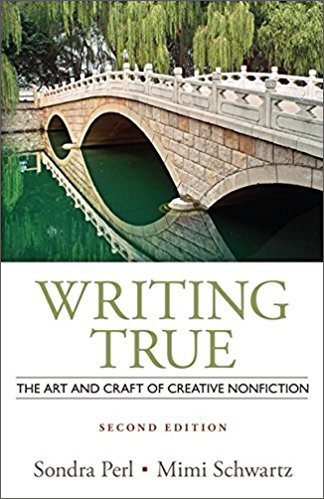
Book CoverWriting True:
The Art and Craft of Creative Nonfiction
A guide to those who want to write about the real world with voice, passion, and the power of story-telling. Filled with strategies, exercises, and wonderful anthology of contemporary creative nonfiction, it offers writers of all levels fresh options for writing memoir, personal essays, profiles, family history, and literary journalism. Co-authored with Sondra Perl. Read more...

Available at amazon

Short Works

Small Decencies
adapted from Good Neighbors, Bad Times

In 1938, while synagogues burned all over Nazi Germany, a Torah was saved in my father’s German village. Not by the Jews, but by Christians. I saw it almost fifty years later in a Memorial Room in Israel, built by Jews who fled after that night, Kristallnacht, and started again a continent away. I can still hear the old man in a kibbutz cap, saying: “Ja, Nazi hoodlums from outside, from Sulz, came to destroy the synagogue, but the Christians decided to save what they could for the Jews. And so we have this still!” Read the entire essay. (MS Word)

Writing About Family: Is It Worth It?
from The Writer's Chronicle

Write what you know!” is the advice given freely to writers not engaged in academic research and journalism—and what we know best involves family. If that becomes a problem, fiction writers and poets have some wiggle room. They can say, “Hey that’s not you! That’s my imagination at work!” and hope for grace. Memoirists and personal essayists have no such cover. The pact we make with our readers is “This is all true!” and truth is expected, even if we include disclaimers such as “To protect those who didn’t ask to be in this story, I’ve changed some names and locales.” With close relatives—mothers, fathers, grandparents, siblings—not even this safety option is possible if we call our work memoir. Which is happening more and more in our age of Oprah, reality TV, memoir courses, grass roots publications, not to mention the over thirty million, true-story books sold last year. Read the entire essay. (MS Word)

The Power of the Cap
--from Thoughts from a Queen-Sized Bed (first appeared in Brevity)

I used to drive defensively through thirty miles of back roads on my way to work. In a land of pick-up trucks and long-finned, rusty Cadillacs, if I overtook, or tailgated, or flicked my brights too often, I could get the finger. Or an angry male might speed up, so I couldn't pass in time to avoid an oncoming car without braking hard into retreat--or heading for the graveled shoulder.  Read the entire essay. (MS Word)

Sharing Stories
from New Jersey Monthly

Fourteen years ago, when I was diagnosed with breast cancer, I gathered every good story I could: about my college roommate’s mother who had breast cancer 35 years before; about my colleague who called to say she’d had a double mastectomy ten years earlier; about my good friend Sue who had had three lymph nodes removed and ten months of chemotherapy and looked terrific three years later, better than before. Read the entire essay (MS Word)


Good Neighbors, Bad Times

“A fascinating picture, atypical of so much written on the subject. Blessed with good antennae and a skeptical mind, Ms. Schwartz is not an innocent abroad. Never gullible or credulous, but open to the evidence of her own eyes and ears, she is an ideal guide to her father’s lost world, which for so long she resisted…. It is a measure of her nuanced approach and refusal to settle for pat, simplistic answers that her book finds and genuinely values a rare point of light in that darkest of times without ever exaggerating its overall significance.”
—The Washington Times

A shrewd and insightful mediation on how our collective histories are discovered, constructed, revised, and debated—and how, finally, we learn to live with them.
– Michael Walzer, author of
Just and Unjust Wars.

Unlike profiles of Oskar Schindler and Raul Wallenberg…Schwartz focuses on the everyday kindnesses practiced on a small scale, neighbor to neighbor [such as] “The barber cut Jewish hair under the sign NO JEWS ALLOWED HERE” to “Christians paid back debts to Jews even though the law said they didn’t have to…” These may be “small acts of defiance,” Schwartz concludes, “but “decency is so often such a solitary act; it’s evil that draws a noisy crowd.”
—JBooks. com

“Schwartz’s excellent presentation defies categorization. It has some elements of journalism, autobiography, history, reporting, feature writing, and literature. All these components are creatively combined to result in an eminently readable product that grips the reader’s attention. Schwartz has augmented our limited capacity to comprehend the Holocaust, which is ultimately an incomprehensible phenomenon.”
—Morton I. Teicher,
National Jewish Post & Opinion.

“This book of moments and little stories surprises and horrifies, soothes and disturbs. But it is, above all, a beautiful read by a charming writer.”
– Aviva Kushner, The Wilson Quarterly.

Thoughts from a Queen-Sized Bed

“A queen-size bed may sound roomy, but when it is shared by a couple married for 40 years ...such a bed becomes a place where thoughts — on love, negotiating a long partnership, motherhood, staying faithful — and memories flow powerfully.”
--The New York Times

"I laughed and sighed and loved reading Thoughts from a Queen-Sized Bed from start to finish. Schwartz, who is a writer, professor, wife, mother, and friend, resists stereotypes of class, gender, and age to find or make, in lovely clear prose, the sweetness of life for her audience. Do yourself a favor. Read this book.” –Hilda Raz, author of What Becomes You

Writing True

"Indispensable for anyone drawn to trying his or her hand at creative nonfiction…a great choice for classrooms, writing groups, and the desktops of writers exploring the genre on their own."
—Lynn Powell, Oberlin College

"I’d like to take my phone off the hook, plug in an automated “Out of the Office” email message, and take this book with me…for a one-month island writing retreat.” –Stephanie Paterson, Cal State University